 DunkRise
Squat to body weight ratio
How much you squat doesn’t tell you how strong you are for your size. Divide it by your body weight and you get a number you can compare with anyone.
Ratio = squat ÷ body weight
Squat 262 lb at a body weight of 175 lb and your ratio is 1.5×. It works the same in kilos.
Why body weight matters
When you jump, the weight you move is you. So for jumping, what counts isn’t how much you lift. It’s how much you lift for your size.
Estimate your max from one set
You don’t need to test a one-rep max. Take one hard set of 2 to 10 reps and estimate it:
Max ≈ weight × (1 + reps ÷ 30)
225 lb for 5 reps: 225 × (1 + 5 ÷ 30) ≈ 262 lb.
| Reps | Multiply by | 225 lb set |
|---|---|---|
| 2 | × 1.07 | 240 lb |
| 3 | × 1.10 | 248 lb |
| 4 | × 1.13 | 255 lb |
| 5 | × 1.17 | 263 lb |
| 6 | × 1.20 | 270 lb |
| 7 | × 1.23 | 278 lb |
| 8 | × 1.27 | 285 lb |
| 9 | × 1.30 | 293 lb |
| 10 | × 1.33 | 300 lb |
This is the Epley formula. Past 10 reps the estimate gets less reliable.
What’s a good squat to body weight ratio?
| Lift | Men | Women |
|---|---|---|
| Back squat | 1.75× | 1.25× |
| Front squat | 1.25× | 1.0× |
| Goblet squat | 0.55× | 0.4× |
Intermediate standards from Strength Level. Compare each lift to its own goal. At 1.5× on a back squat, a man is 86% of the way there.
How much should you squat for your weight?
| Body weight | Squat for a ratio of | |||
|---|---|---|---|---|
| 1.25× | 1.5× | 1.75× | 2× | |
| 120 lb | 150 | 180 | 210 | 240 |
| 130 lb | 165 | 195 | 230 | 260 |
| 140 lb | 175 | 210 | 245 | 280 |
| 150 lb | 190 | 225 | 265 | 300 |
| 160 lb | 200 | 240 | 280 | 320 |
| 170 lb | 215 | 255 | 300 | 340 |
| 180 lb | 225 | 270 | 315 | 360 |
| 190 lb | 240 | 285 | 335 | 380 |
| 200 lb | 250 | 300 | 350 | 400 |
| 210 lb | 265 | 315 | 370 | 420 |
| 220 lb | 275 | 330 | 385 | 440 |
| 230 lb | 290 | 345 | 405 | 460 |
| 240 lb | 300 | 360 | 420 | 480 |
| 250 lb | 315 | 375 | 440 | 500 |
| 260 lb | 325 | 390 | 455 | 520 |
Squat in pounds, rounded to 5 lb.
| Body weight | Squat for a ratio of | |||
|---|---|---|---|---|
| 1.25× | 1.5× | 1.75× | 2× | |
| 55 kg | 70 | 82.5 | 97.5 | 110 |
| 60 kg | 75 | 90 | 105 | 120 |
| 65 kg | 82.5 | 97.5 | 115 | 130 |
| 70 kg | 87.5 | 105 | 122.5 | 140 |
| 75 kg | 95 | 112.5 | 132.5 | 150 |
| 80 kg | 100 | 120 | 140 | 160 |
| 85 kg | 107.5 | 127.5 | 150 | 170 |
| 90 kg | 112.5 | 135 | 157.5 | 180 |
| 95 kg | 120 | 142.5 | 167.5 | 190 |
| 100 kg | 125 | 150 | 175 | 200 |
| 105 kg | 132.5 | 157.5 | 185 | 210 |
| 110 kg | 137.5 | 165 | 192.5 | 220 |
| 115 kg | 145 | 172.5 | 202.5 | 230 |
| 120 kg | 150 | 180 | 210 | 240 |
Squat in kilograms, rounded to 2.5 kg.
Get an honest number
- Squat to parallel or deeper. Half reps make your ratio look better than it is.
- Use 10 reps or fewer. The estimate gets worse past that.
- Use a recent weigh-in. Not what you weighed last summer.
Two ways to raise it
Lift more, or carry less weight that doesn’t help you jump. Either one raises your ratio, and both make you springier.
Strength is the base, not the whole thing. Once you’re strong for your size, getting faster and springier off the ground usually pays off more than adding weight to the bar. To see where your jump is, measure your vertical jump with your phone.
Track it in DunkRise
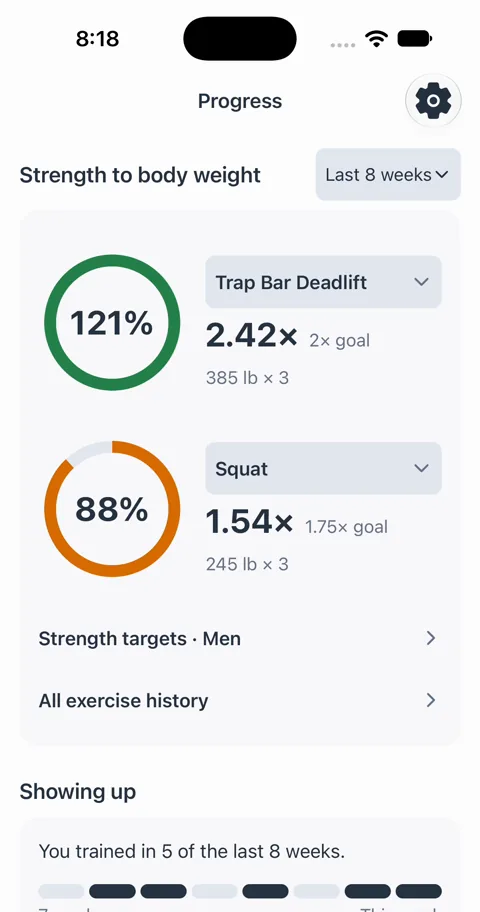
Log your squats and your weight. DunkRise shows your ratio and how close you are to your goal.


FAQ
What is a good squat to body weight ratio?
For a back squat, 1.75× body weight for men and 1.25× for women is a solid goal. Many people start under 1×.
How much should I squat if I weigh 180 lb?
1.5× is 270 lb, 1.75× is 315 lb and 2× is 360 lb. The chart above covers 120 to 260 lb.
Do I need to test a one-rep max?
No. A hard set of 2 to 10 reps gives a close estimate, and it’s easier on your body than a max attempt.
Does a bigger squat mean a higher vertical jump?
Strength for your size helps you jump, but it’s only part of it. Once you’re strong for your size, getting faster and springier usually pays off more.
Related: Measure your vertical jump · How high you need to jump to dunk